SAP P_BTPA_2511 Study Guide: Advanced BTP Architecture and Design
Introduction: Building Expertise in SAP Business Technology Platform
Modern enterprises need technology platforms that connect business applications, simplify data management, support cloud-native development, and enable secure digital transformation. SAP Business Technology Platform (SAP BTP) brings these capabilities together, helping organizations develop, integrate, extend, and manage business solutions within a flexible cloud environment.
For professionals preparing for the P_BTPA_2511 certification, developing architectural knowledge involves more than memorizing technical terminology. It requires understanding business requirements, selecting suitable platform services, evaluating integration approaches, and designing solutions that balance security, scalability, performance, and maintainability.
This guide introduces essential concepts and practical preparation strategies to help candidates strengthen their understanding of SAP BTP architecture and design.
FOR MORE INFORMATION CLICK HERE: https://boost2certify.com/product/p_btpa_2511/
Understanding SAP Business Technology Platform
SAP BTP is a cloud-based platform that enables organizations to build applications, integrate business systems, manage data, and extend existing SAP solutions. It supports businesses as they modernize their technology environments while maintaining connections between existing enterprise systems and newer cloud applications.
A well-designed SAP BTP solution begins with a clear understanding of business objectives. Architects must determine which capabilities are required, how applications will communicate, where data will be processed, and which security controls must be applied.
Key areas to understand include:
- Application development and extension.
- Enterprise application integration.
- Data management and analytics.
- Identity and access management.
- Cloud infrastructure and runtime environments.
- Governance, monitoring, and operational management.
Understanding the relationship between these capabilities provides a strong foundation for exploring advanced architecture and design scenarios.
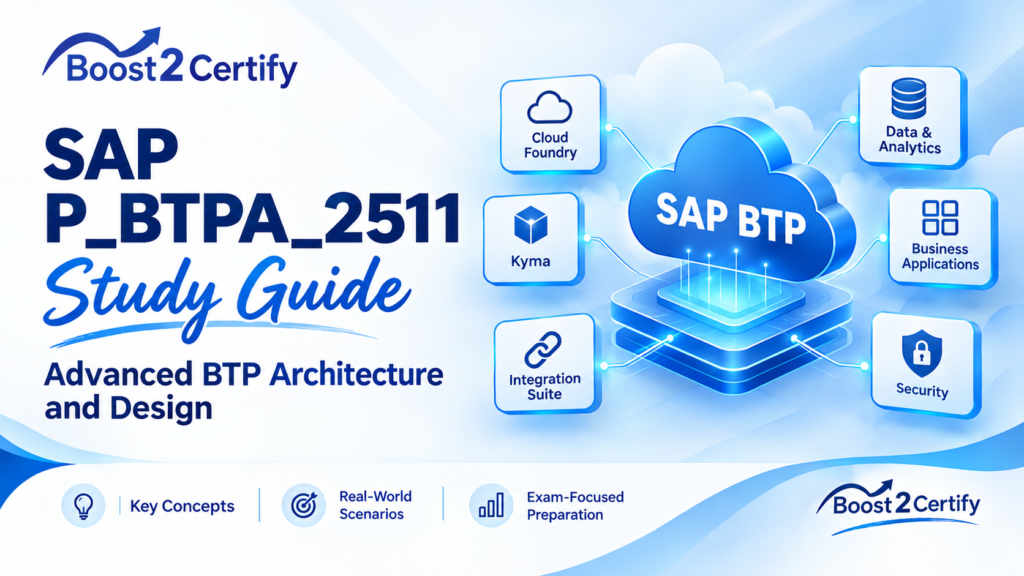
Exploring the Core Architecture of SAP BTP
SAP BTP architecture involves multiple interconnected components that work together to support enterprise workloads. The appropriate architecture depends on the organization’s existing systems, application requirements, integration needs, and operational expectations.
1. Global Accounts, Directories, and Subaccounts
Understanding SAP BTP’s account structure is important when designing an environment for development, testing, and production.
Global accounts provide a high-level organizational structure for managing platform entitlements and resources. Directories can help organize subaccounts, while subaccounts provide environments for configuring services, managing access, and deploying workloads.
Architects should understand how these elements support:
- Separation of development, testing, and production environments.
- Resource and entitlement management.
- Administrative responsibilities and access boundaries.
- Consistent governance across business units.
- Operational control over different workloads.
A carefully planned account structure makes it easier to maintain consistency as an SAP BTP landscape grows.
2. Runtime Environments and Application Deployment
SAP BTP supports different approaches to application deployment, depending on the selected runtime and development model.
Cloud Foundry provides an application platform for deploying and managing cloud applications. Kyma provides a Kubernetes-based environment suited to containerized workloads and cloud-native development scenarios.
The selection of a runtime should be based on application requirements rather than a preference for a particular technology.
Important design considerations include deployment processes, application dependencies, resource requirements, connectivity, monitoring, and operational complexity.
Candidates should develop a conceptual understanding of the differences between runtime environments and recognize the circumstances in which each approach may be appropriate.
3. Service Selection and Entitlements
SAP BTP offers services for development, integration, security, data management, and other enterprise requirements. However, not every service is necessary for every solution.
Architects must identify the capabilities required by the business and determine which services support those requirements. They should also consider service availability, entitlements, dependencies, regional availability, and operational responsibilities.
Effective service selection helps prevent unnecessary complexity and supports a more manageable platform architecture.
Advanced BTP Architecture and Design Principles
Advanced architecture requires a balance between technical capability and business value. A solution should meet current requirements while remaining adaptable to future changes.
Designing for Scalability
Scalability enables an application to accommodate changing workloads and business demand. Architects should assess expected usage patterns, application dependencies, resource consumption, and the capabilities of the chosen runtime.
A scalable design may involve stateless application components, efficient API interactions, suitable caching strategies, and appropriate resource allocation where supported.
Candidates should understand that scalability is not achieved simply by adding resources. The entire application architecture, including integrations and databases, must be considered.
Designing for High Availability and Resilience
Enterprise applications often support business-critical processes. Their architecture should therefore account for service interruptions, dependency failures, recovery requirements, and continuity objectives.
Important concepts include redundancy, health monitoring, recovery planning, dependency management, and testing failure scenarios.
Architects should distinguish between availability and disaster recovery. Availability focuses on maintaining service access, while disaster recovery addresses the restoration of services following a significant disruption.
The appropriate design depends on business impact, recovery objectives, technical constraints, and the capabilities of the underlying services.
Security by Design
Security must be considered throughout the solution lifecycle rather than added after deployment.
An SAP BTP architecture should account for identity management, authentication, authorization, secure communication, credential handling, and appropriate access restrictions.
The principle of least privilege is particularly important: users and applications should receive only the permissions necessary to perform their assigned responsibilities.
Architects should also understand the importance of protecting sensitive information, managing credentials securely, reviewing access permissions, and monitoring relevant security events.
Integration and Connectivity
Enterprise solutions frequently require communication between cloud applications, SAP systems, third-party services, and on-premises environments.
SAP BTP integration capabilities can support these requirements through appropriate integration services, APIs, connectivity options, and event-driven approaches.
A successful integration design considers data formats, authentication, network boundaries, error handling, performance, and the reliability of communication between systems.
Candidates should understand how to evaluate integration patterns according to business requirements rather than assuming that one approach suits every scenario.
SAP BTP Integration and Application Extension
Application integration and extension are central to many SAP BTP implementations.
API-Based Integration
APIs provide defined interfaces through which applications can exchange information or access functionality. Architects should understand API security, interface design, versioning, error handling, and lifecycle management.
Well-designed APIs improve interoperability and reduce unnecessary dependencies between systems.
Event-Driven Architecture
Event-driven designs allow applications and services to respond to events rather than relying exclusively on direct, synchronous communication.
This approach can support loosely coupled systems and asynchronous business processes. However, it also introduces considerations such as event ordering, duplicate processing, retries, and eventual consistency.
Understanding these trade-offs helps architects select suitable communication patterns for different workloads.
Extending SAP Applications
Organizations may need to add functionality to existing SAP applications without creating unnecessary changes to their core systems.
SAP BTP can support extension strategies that use cloud services, APIs, and other platform capabilities to implement additional business requirements.
Architects should evaluate extension options based on maintainability, upgrade compatibility, integration complexity, and long-term business needs.
Data Management and Analytics Considerations
Data is an essential part of enterprise architecture. Business applications depend on accurate, accessible, and appropriately governed information.
When designing SAP BTP solutions, architects should understand how data sources, processing services, analytics capabilities, and application requirements interact.
Key considerations include:
- Data integration and transformation.
- Data quality and consistency.
- Appropriate access controls.
- Data privacy and governance.
- Analytical workload requirements.
- Data movement, latency, and storage considerations.
A suitable design should provide the necessary business insights while respecting organizational policies and technical constraints.
Candidates should focus on understanding the purpose of relevant data and analytics capabilities rather than treating every available service as interchangeable.
Governance, Monitoring, and Operational Excellence
A platform architecture is only effective when it can be operated reliably after implementation.
Governance establishes how platform resources are organized, who can access them, and how standards are maintained across environments. Monitoring helps teams understand application health, identify performance issues, and investigate failures.
An operationally mature design should consider logging, alerting, deployment controls, configuration management, and incident response.
Architects should also understand how development and production environments can be separated to reduce risk and support controlled releases.
These operational considerations contribute to a more predictable and maintainable SAP BTP landscape.
Practical Architecture Scenarios for Exam Preparation
Scenario-based learning is a valuable way to connect technical knowledge with architectural decision-making.
Scenario 1: Selecting an Appropriate Runtime
An organization plans to develop a new business application and must choose a suitable runtime.
The architect should examine the application’s programming model, deployment requirements, container dependencies, scaling expectations, and operational capabilities before selecting a platform environment.
Learning objective: Understand how workload characteristics influence runtime selection.
Scenario 2: Connecting Cloud and On-Premises Systems
A business needs to integrate a cloud application with an existing on-premises system.
The architect should assess connectivity requirements, authentication, network restrictions, data exchange patterns, and failure-handling strategies.
Learning objective: Evaluate integration and connectivity decisions in the context of enterprise requirements.
Scenario 3: Improving Application Security
A company wants to ensure that employees and applications can access only the resources they need.
The architect should consider identity services, role assignments, authentication methods, authorization policies, and secure credential management.
Learning objective: Apply security principles to platform architecture.
Scenario 4: Supporting Future Business Growth
An organization expects its application workload to increase significantly over time.
The architect should evaluate application design, resource allocation, service limits, performance bottlenecks, and monitoring requirements.
Learning objective: Understand how scalability and operational planning influence architectural decisions.
Working through scenarios like these helps candidates develop the reasoning skills needed to evaluate different technical options.
Effective Preparation Strategies for P_BTPA_2511
Preparing for a certification requires a structured approach that combines conceptual learning, practical exploration, and regular revision.
Build a Topic-Based Study Plan
Divide your preparation into manageable areas, such as platform architecture, runtime environments, integration, security, application extension, and operational management.
Assign study sessions to each area and review difficult concepts regularly. This approach helps maintain consistent progress and makes knowledge gaps easier to identify.
Use Official Learning Resources
Begin with the current official SAP learning materials and certification information applicable to P_BTPA_2511. Verify the current exam scope, available learning journeys, and any relevant prerequisites before finalizing your study plan.
Supplement these materials with product documentation that explains platform capabilities, configuration choices, and architectural considerations.
Practice Architectural Decision-Making
For each major topic, ask yourself:
- What business requirement does this capability address?
- Which architectural options are available?
- What are the advantages and limitations of each option?
- What security or integration concerns must be considered?
- How would the solution be maintained after deployment?
These questions encourage understanding instead of relying entirely on memorization.
Review Your Weak Areas
Use practice questions and self-assessments to identify topics that require additional attention. Review the reasoning behind each answer and consult trusted learning resources when a concept remains unclear.
Practice material should reinforce genuine understanding and should not replace official documentation or hands-on learning.
How P2PExam Study Resources Can Support Your Preparation
P2PExam provides a platform for candidates exploring certification-related study resources and preparation materials.
For learners preparing for SAP P_BTPA_2511, relevant study resources can help organize revision, revisit important concepts, and reinforce understanding of advanced BTP architecture and design.
Candidates should select resources that align with the applicable certification objectives and complement official SAP documentation. A balanced preparation strategy combines conceptual study, practical exercises, scenario-based review, and ongoing assessment.
Rather than focusing solely on remembering answers, use each practice exercise to understand the architectural principle behind the decision. This creates a stronger foundation for applying technical knowledge to unfamiliar situations.
Explore the relevant certification preparation resources at P2PExam and build a study routine that supports your learning goals.
Common Preparation Mistakes to Avoid
Even well-prepared candidates can struggle when their revision focuses on memorization instead of understanding.
Avoid these common mistakes:
- Ignoring architecture fundamentals: Advanced topics become easier when account structures, services, runtimes, and security concepts are understood first.
- Choosing services without evaluating requirements: Different workloads require different combinations of capabilities.
- Overlooking security: Identity, access, and credential management should be part of architectural decisions from the beginning.
- Neglecting integration patterns: Understand the trade-offs between different communication and connectivity approaches.
- Relying on a single preparation source: Cross-check important concepts against current official documentation.
- Skipping scenario practice: Architectural questions often require selecting the most suitable option for a particular business situation.
Avoiding these habits can make study sessions more productive and improve your ability to explain technical decisions.
Conclusion: Strengthen Your SAP BTP Architecture Knowledge
The SAP P_BTPA_2511 Study Guide: Advanced BTP Architecture and Design provides a structured starting point for exploring the concepts that support modern SAP BTP solutions.
Developing a strong understanding of platform architecture, runtime environments, integration, security, scalability, data management, and governance can help candidates approach certification preparation with greater clarity.The most effective learning process combines official resources, consistent revision, practical exploration, and scenario-based reasoning. By understanding why an architectural decision is appropriate—not simply memorizing what to select—learners can build knowledge that extends beyond exam preparation.Use this guide as part of a broader study strategy, validate the current certification requirements through official SAP channels, and continue strengthening your understanding of the platform.
SAP #SAPBTP #P_BTPA_2511 #SAPCertification #SAPBTPArchitecture #BTPArchitecture #CloudArchitecture #EnterpriseArchitecture #SAPIntegration #CloudComputing #SAPLearning #P2PExam #ITCertification #TechnicalArchitecture #CertificationPreparation
Prepare with purpose, understand the architecture, and take the next step toward your SAP BTP learning goals with P2PExam : https://boost2certify.com/product/p_btpa_2511/