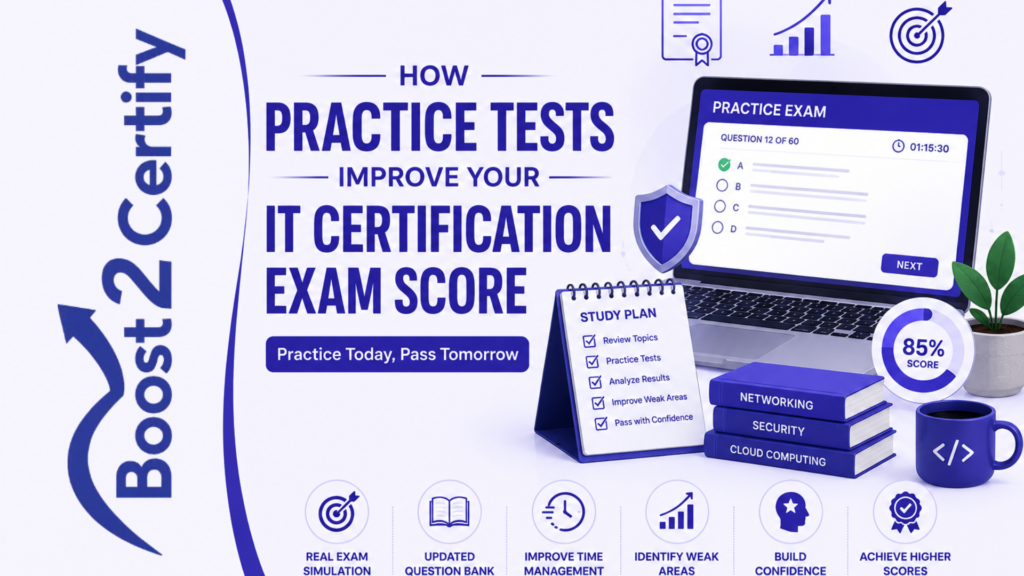
How Practice Tests Improve Your IT Certification Exam Score
Preparing for an IT certification exam can feel overwhelming. Whether you’re studying for CompTIA, Microsoft, Cisco, AWS, VMware, or another industry-recognized certification, there’s often a mountain of information to absorb in a limited amount of time. Many candidates spend weeks reading textbooks, watching online courses, and reviewing notes only to discover during the actual exam that they weren’t fully prepared for the way questions were presented.
That’s where practice tests make a significant difference.
Practice exams don’t just help you memorize facts they train your brain to think the way the real exam expects you to. They help you identify knowledge gaps, improve your time management, reduce test anxiety, and build the confidence needed to perform at your best.
In this guide, we’ll explore how practice tests can dramatically improve your IT certification exam score and why they’re an essential part of any successful study strategy.
Why Practice Tests Are Essential for IT Certification Success
Reading study guides provides knowledge, but applying that knowledge under exam conditions is a completely different challenge.
Practice tests bridge that gap by simulating the experience of taking the actual certification exam. Instead of simply recognizing information, you’re required to analyze questions, evaluate possible answers, and make decisions under time constraints.
This active learning process strengthens your understanding and helps you retain information more effectively than passive reading alone.
The Science Behind Practice Testing
Educational research consistently shows that retrieval practice the act of recalling information from memory—is one of the most effective ways to improve long-term learning.
Every time you complete a practice test, your brain strengthens the connections between concepts, making it easier to retrieve that information later during the real exam.
Rather than rereading the same chapter multiple times, testing yourself forces your brain to work harder, leading to better retention and deeper understanding.
Identify Knowledge Gaps Before Exam Day
One of the biggest advantages of practice exams is that they reveal what you don’t know.
Many learners assume they understand a topic until they attempt exam-style questions.
For example, you may feel confident about cloud computing concepts after reading a chapter, but a practice test might reveal that you’re struggling with scenario-based questions involving Azure services or AWS architecture.
Once these weak areas are identified, you can:
- Focus your study sessions more effectively
- Avoid wasting time reviewing topics you’ve already mastered
- Prioritize difficult domains
- Track your progress over time
This targeted approach makes your study plan much more efficient.
Build Confidence Through Repetition
Confidence isn’t built by hoping you’re ready it comes from experience.
Every completed practice test makes the actual exam feel more familiar.
Instead of facing an unknown challenge, you’ll already understand:
- The style of questions
- The exam format
- Time limits
- Difficulty level
- How to approach complex scenarios
Candidates who regularly complete realistic practice exams often report feeling calmer and more focused on exam day because they’ve already experienced similar testing conditions.
Improve Time Management Skills
Running out of time is one of the most common reasons candidates fail certification exams.
Many IT certification tests include dozens of questions that must be completed within a strict time limit.
Practice tests help you develop:
- Faster decision-making
- Better pacing
- Efficient question review strategies
- Confidence in moving past difficult questions
After several timed practice sessions, you’ll naturally develop a rhythm that helps you manage your time more effectively during the real exam.
Learn How Questions Are Written
IT certification exams don’t simply ask for definitions.
Instead, many questions present real-world scenarios that require analysis and critical thinking.
For example, rather than asking:
“What is multifactor authentication?”
You may be asked:
“A company wants to improve account security while minimizing user inconvenience. Which authentication method should they implement?”
Practice exams expose you to these question styles, helping you recognize patterns and think like the exam writers.
Reinforce Long-Term Memory
Many students rely on reading notes repeatedly, believing repetition alone leads to learning.
Unfortunately, passive reading often creates a false sense of confidence.
Practice tests require active recall, which significantly strengthens memory retention.
Each completed exam reinforces:
- Technical terminology
- Networking concepts
- Security principles
- Cloud services
- Troubleshooting processes
- Best practices
The more often you retrieve information, the easier it becomes to remember during the real exam.
Reduce Exam Anxiety
Test anxiety affects thousands of certification candidates every year.
Even well-prepared professionals can become overwhelmed by:
- Time pressure
- Difficult questions
- Fear of failure
- Unfamiliar testing environments
Practice exams reduce anxiety by making the experience predictable.
The more familiar the exam feels, the less intimidating it becomes.
Instead of wondering what to expect, you’ll already know how to approach each section confidently.
Develop Better Decision-Making Skills
Many certification questions include multiple answers that appear correct.
Your task is identifying the best answer.
Practice testing helps improve:
- Analytical thinking
- Elimination techniques
- Reading comprehension
- Scenario evaluation
- Confidence under pressure
Over time, you’ll begin recognizing common distractors and learning how certification providers structure their questions.
Track Your Progress
One of the biggest motivational benefits of practice exams is measurable improvement.
Instead of guessing whether you’re ready, you can monitor your scores over time.
For example:
| Week | Practice Exam Score |
|---|---|
| Week 1 | 58% |
| Week 2 | 69% |
| Week 3 | 81% |
| Week 4 | 91% |
Seeing steady improvement builds confidence and helps you decide when you’re ready to schedule your certification exam.
Why High-Quality Practice Exam Software Matters
Not all practice tests provide the same value.
High-quality practice exam software is designed to mirror the structure, difficulty, and experience of the actual certification exam.
Reliable exam preparation tools often include:
- Real exam simulations
- Updated question banks aligned with current exam objectives
- Timed testing modes
- Detailed answer explanations
- Performance analytics
- Domain-by-domain score reports
- Custom quizzes for targeted review
Rather than simply checking whether your answer is correct, quality software explains why the correct answer is right and why the other options are not. This deeper understanding helps reinforce key concepts and prepares you for real-world exam scenarios.
Many successful certification candidates combine official study materials with trusted practice exam software to strengthen their knowledge and build confidence before test day. While no reputable provider can promise a guaranteed pass, consistent practice with realistic exam simulations can significantly improve your readiness and overall performance.
Common Mistakes to Avoid When Using Practice Tests
Practice exams are powerful tools, but they should be used correctly.
Avoid these common mistakes:
Memorizing Answers
Focus on understanding the concepts rather than remembering specific answers.
Ignoring Wrong Answers
Every incorrect answer is a learning opportunity. Carefully review the explanation before moving on.
Taking Practice Tests Too Early
Build a basic understanding of the material before attempting full-length mock exams.
Only Taking One Practice Test
Repeated practice helps reinforce learning and exposes you to a wider variety of question types.
Skipping Timed Sessions
Untimed practice is useful initially, but timed exams prepare you for real testing conditions.
Best Strategy for Using Practice Tests
A balanced study plan might look like this:
Week 1
- Learn exam objectives
- Read study materials
- Watch training videos
Week 2
- Continue studying
- Complete short topic-based quizzes
Week 3
- Begin full-length practice exams
- Review incorrect answers
- Focus on weaker domains
Week 4
- Take multiple timed practice exams
- Improve pacing
- Review notes
- Build confidence
This structured approach helps maximize retention while avoiding burnout.
Who Benefits Most from Practice Exams?
Practice tests are valuable for almost every certification candidate, including:
- First-time IT learners
- College students
- Career changers
- Help Desk professionals
- System Administrators
- Network Engineers
- Cloud Engineers
- Cybersecurity Analysts
- Experienced professionals renewing certifications
Regardless of your experience level, realistic practice helps bridge the gap between studying and passing.
Frequently Asked Questions
Do practice tests really improve certification exam scores?
Yes. Practice tests help reinforce knowledge, improve recall, identify weak areas, and build confidence, all of which contribute to better exam performance.
How many practice exams should I take before the real test?
Most candidates benefit from completing at least three to five full-length practice exams, along with targeted quizzes for weaker topics.
Should I memorize practice test answers?
No. Focus on understanding the concepts and reasoning behind each answer rather than memorizing responses.
Are practice exam questions the same as the real exam?
Reputable practice exam software is designed to simulate the style and difficulty of the actual exam, but the questions themselves are different. The goal is to prepare you for the exam format and concepts not to provide actual exam content.
When should I start taking practice tests?
Begin with topic-based quizzes after you’ve covered the basics. Save full-length, timed practice exams for the final stages of your preparation.
What features should I look for in practice exam software?
Choose software that offers updated question banks, realistic exam simulations, detailed answer explanations, performance tracking, and customizable practice sessions.
Conclusion
Success in IT certification exams isn’t just about how much you study it’s about how effectively you prepare. Practice tests transform passive learning into active problem-solving, helping you identify knowledge gaps, improve time management, reduce exam anxiety, and build lasting confidence.
Whether you’re preparing for CompTIA, Microsoft, Cisco, AWS, VMware, or another certification, incorporating realistic practice exams into your study routine can make a meaningful difference in your performance. By combining official learning resources with trusted practice exam software that includes real exam simulations, updated question banks, and detailed explanations, you’ll be better equipped to approach exam day with confidence.