F5CAB3 Study Guide: Essential F5 Skills for Certification Candidates
Introduction
Application delivery infrastructure supports the availability and performance of business-critical services. When applications receive large volumes of traffic, administrators need effective ways to distribute requests and maintain reliable connections between clients and application servers.
F5 BIG-IP provides capabilities that support traffic management and application delivery. Learning its configuration concepts can help candidates build a foundation for roles involving network administration, application delivery, infrastructure support, and technical troubleshooting.Developing these skills can also improve a candidate’s understanding of how network services interact with application environments.
Enhance your preparation with relevant F5CAB3 practice questions designed to help you assess your knowledge and identify areas for improvement: https://boost2certify.com/product/f5cab3/
Core Technical Areas to Study
1. BIG-IP Architecture and Data-Plane Fundamentals
Start by understanding the role of BIG-IP in an application delivery environment. Learn how incoming client requests are processed and forwarded toward the appropriate application resources.
Important learning areas include:
- The purpose of BIG-IP in application delivery.
- The distinction between data-plane and control-plane responsibilities.
- How client requests travel through an application delivery system.
- The relationship between virtual servers, pools, and pool members.
- How configuration components contribute to traffic handling.
A clear understanding of these fundamentals makes more advanced configuration topics easier to learn.
2. Virtual Server Configuration
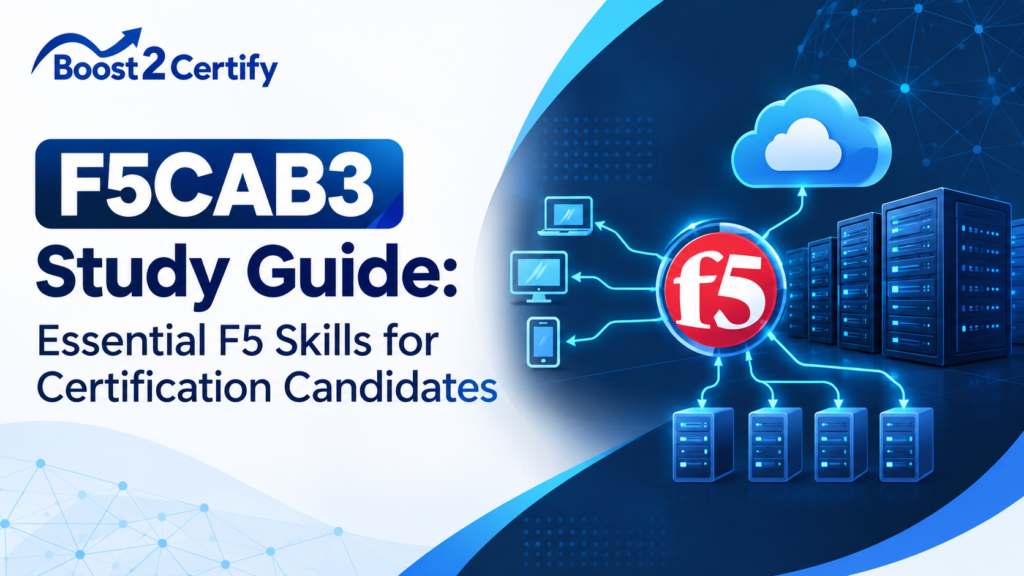
Virtual servers are a central part of BIG-IP traffic management. They provide defined points through which client traffic can enter a configured application delivery environment.
Candidates should understand the purpose of a virtual server, its relationship with traffic destinations, and how its configuration influences request processing.
During preparation, focus on:
- Understanding virtual server functionality.
- Identifying relevant configuration properties.
- Recognizing the relationship between virtual servers and pools.
- Understanding how configuration choices affect traffic delivery.
- Reviewing common reasons a virtual server might not handle traffic as expected.
Practical examples are particularly useful in this area. For instance, consider an application that users cannot access even though its backend servers appear to be running. Understanding virtual server configuration helps you investigate the relevant traffic path systematically.
3. Pools and Pool Members
Pools organize application resources so that traffic can be directed to suitable backend servers. Pool members represent the individual resources that participate in serving application requests.
Candidates should understand how pools support application availability and how their configuration affects traffic distribution.
Study the following concepts:
- The purpose of a pool.
- The relationship between pools and virtual servers.
- How pool members are defined.
- The role of load-balancing methods.
- The importance of member availability and health monitoring.
- How incorrect pool configuration can affect application access.
Consider a web application supported by several backend servers. If one server becomes unavailable, the administrator needs to understand how pool status and monitoring information affect traffic handling.
Being able to explain this relationship is more useful than simply memorizing terminology.
4. Traffic Flow and Load Balancing
Traffic flow is another important area of BIG-IP administration. Candidates should understand how requests reach a virtual server and how the configured environment directs those requests toward backend resources.
Review the relationship between incoming connections, virtual servers, pools, and pool members. Learn how load-balancing decisions influence which application resources receive requests.
It is also helpful to understand common traffic-management scenarios, such as a service becoming unavailable, a pool member failing a health check, or an application experiencing uneven traffic distribution.
When studying these scenarios, focus on identifying the underlying configuration or availability issue rather than immediately assuming that every problem has the same cause.
5. Health Monitoring and Availability
Application availability depends on more than whether a server is powered on. Administrators must also consider whether the relevant service is responding as expected.
Health monitoring helps BIG-IP assess the availability of configured resources. Candidates should understand the purpose of monitors, the information they provide, and how monitor results can influence the availability of pool members.
Useful study questions include:
- Why are health monitors important?
- How can an unavailable pool member affect an application?
- What information should be checked when a member is marked unavailable?
- How can monitoring results help narrow down a configuration problem?
A structured understanding of monitoring makes it easier to analyze application delivery issues.
6. Configuration Validation and Troubleshooting
Troubleshooting requires a logical process. Rather than changing multiple settings at once, administrators should examine the available evidence, identify possible causes, and verify each finding.
For F5CAB3 preparation, practise explaining how you would investigate issues involving virtual servers, pools, and pool members.
A useful troubleshooting approach is to:
- Define the reported problem clearly.
- Identify which BIG-IP components are involved.
- Review the relevant configuration.
- Examine availability and monitoring information.
- Check the expected traffic path.
- Test a possible explanation and verify the outcome.
This method encourages careful reasoning and helps develop skills that are useful beyond the certification exam.
Building an Effective F5CAB3 Study Plan
A structured study plan helps candidates cover the necessary concepts without becoming overwhelmed.
Step 1: Review the Official Exam Blueprint
Begin with the current F5CAB3 exam page and the applicable certification blueprint. Use the listed objectives to identify the topics that require the most attention.
Avoid relying exclusively on unofficial topic lists, because exam information and certification requirements can change.
Step 2: Strengthen Your Technical Foundations
Review networking fundamentals relevant to application delivery, including IP addressing, TCP/IP, ports, routing concepts, and client-server communication.
These concepts provide context for understanding how BIG-IP processes and forwards traffic.
Step 3: Study One Configuration Area at a Time
Divide your preparation into manageable topics. Begin with BIG-IP fundamentals, move to virtual servers, and then study pools, pool members, monitoring, and traffic flow.
After each topic, summarize the main concepts in your own words. This helps reveal whether you understand the material or have only memorized its terminology.
Step 4: Use Practical Examples
Where access to an authorized BIG-IP lab or learning environment is available, practise examining configurations and interpreting system status.
Practical learning can help you connect theoretical knowledge with real administrative tasks. If a lab is unavailable, use diagrams and written scenarios to trace the expected flow of traffic through a BIG-IP environment.
Step 5: Review Questions and Explanations
Practice questions can help you identify knowledge gaps and become familiar with technical question formats.
After answering a question, review the reasoning behind the correct answer. If you make a mistake, revisit the relevant concept instead of memorizing the answer alone.
Use practice resources that are clearly aligned with the current exam objectives and that explain the technical reasoning.
Step 6: Evaluate Your Readiness
Before scheduling the exam, review each major topic and identify areas where you still need more practice.
You should be able to explain virtual servers, pools, pool members, traffic distribution, and health monitoring in your own words. You should also be comfortable analyzing basic configuration scenarios.
Common Preparation Mistakes to Avoid
Memorizing Without Understanding
Memorization may help with terminology, but configuration questions often require you to understand how different components interact. Focus on relationships, practical examples, and the reasons behind configuration decisions.
Ignoring Networking Fundamentals
A weak understanding of basic networking can make application delivery concepts harder to follow. Review relevant networking principles whenever a BIG-IP topic depends on them.
Studying Without a Plan
Moving randomly between unrelated topics can leave important knowledge gaps. Use the exam blueprint to organize your preparation and track your progress.
Relying on a Single Resource
One study resource may not explain every concept in sufficient depth. Combine official documentation, appropriate training, practical examples, and carefully selected practice questions.
Skipping Review Sessions
Revisiting previously studied material helps reinforce learning. Reserve time for reviewing difficult concepts and correcting recurring mistakes.
How P2PExam Study Resources Can Support Preparation
Candidates looking for additional preparation materials can explore relevant study resources from P2PExam. A structured study resource may help organize revision, revisit important concepts, and identify topics that deserve further attention.
For the F5CAB3 exam, candidates should prioritize resources that cover BIG-IP data-plane configuration and align with the current exam objectives. Use supplementary questions to test understanding, not as a substitute for learning the technology.Always compare third-party materials with official F5 documentation and verify that the resources are relevant to the exam you intend to take. No third-party study guide or question collection can guarantee a passing result.
Final Preparation Checklist
Before taking the F5CAB3 exam, make sure you can:
- Explain the role of BIG-IP in application delivery.
- Distinguish data-plane responsibilities from control-plane responsibilities.
- Describe how virtual servers and pools work together.
- Explain the purpose of pool members and health monitors.
- Understand basic traffic distribution concepts.
- Interpret common configuration and availability scenarios.
- Use official exam objectives to guide revision.
- Identify and strengthen your weaker technical areas.
Conclusion
Preparing for the F5CAB3 certification requires a combination of conceptual understanding, structured revision, and practical reasoning. By focusing on BIG-IP architecture, virtual server configuration, pools, traffic flow, monitoring, and troubleshooting, candidates can build a stronger foundation in application delivery administration.An organized study plan, relevant practice questions, and consistent review can make preparation more manageable. Most importantly, candidates should aim to understand how BIG-IP components work together rather than relying on memorization alone.With focused preparation and reliable learning resources, aspiring administrators can develop valuable technical knowledge and approach their certification goals with greater confidence.
Hashtags
#F5CAB3 #F5Certification #F5BIGIP #F5Networks #CertificationPreparation #BIGIPAdministration #NetworkAdministration #ApplicationDelivery #ITCertification #NetworkEngineering #TechnicalSkills #ExamPreparation #P2PExam
Explore relevant certification preparation resources at P2PExam and use them alongside official F5 documentation to support your learning journey: https://boost2certify.com/product/f5cab3/