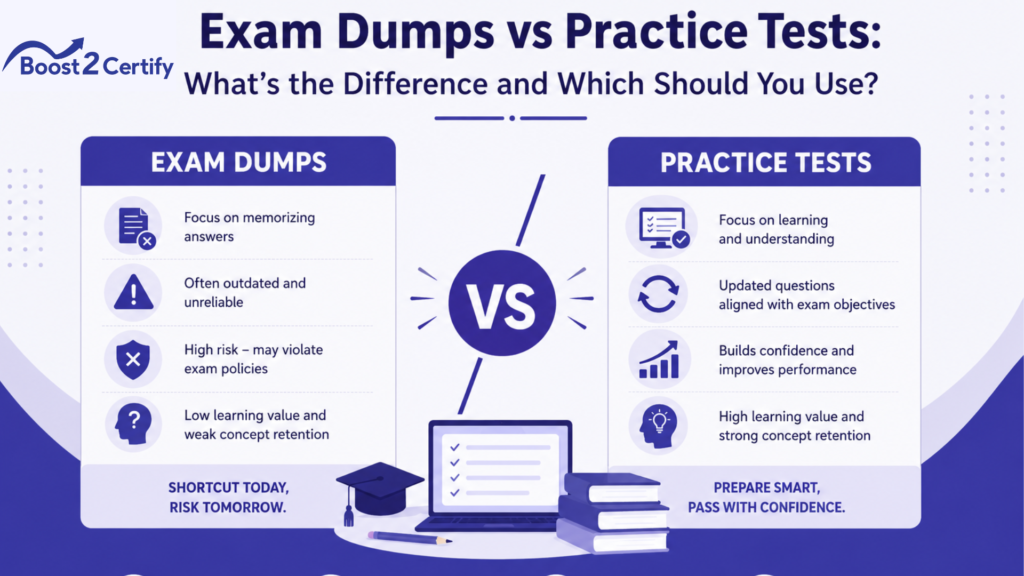
Exam Dumps vs Practice Tests: What’s the Difference and Which Should You Use?
Preparing for a certification exam can feel overwhelming, especially when you’re faced with dozens of study resources claiming they’ll help you pass. Two of the most common options you’ll encounter are exam dumps and practice tests. At first glance, they may seem similar they both contain exam-related questions but they serve very different purposes.
Choosing the wrong resource can leave you underprepared, waste valuable study time, or even put your certification at risk. On the other hand, selecting high-quality practice materials can significantly improve your confidence, strengthen your understanding, and help you perform your best on exam day.
In this guide, we’ll break down the differences between exam dumps and practice tests, explain the pros and cons of each, and help you determine which option supports long-term certification success.
What Are Exam Dumps?
Exam dumps are collections of questions and answers that claim to come directly from actual certification exams. In many cases, these questions are shared by previous test-takers without authorization from the certification provider.
The goal of exam dumps is simple: memorize the answers instead of learning the concepts.
While this approach may sound appealing, it comes with significant drawbacks.
Common Characteristics of Exam Dumps
- Questions are often copied from real exams.
- Little or no explanation is provided.
- Content may be outdated.
- Answers can be incorrect.
- They often violate certification provider policies.
Many certification organizations including Microsoft, Cisco, CompTIA, AWS, and VMware strictly prohibit the use of unauthorized exam content. Candidates caught using exam dumps may face exam invalidation, certification revocation, or permanent testing bans.
What Are Practice Tests?
Practice tests are legitimate learning resources designed to simulate the real certification exam while helping candidates understand the material.
Rather than encouraging memorization, quality practice exams reinforce concepts, identify knowledge gaps, and prepare you for the actual testing experience.
Professional practice exam software often includes detailed explanations, performance analytics, and timed exam simulations that closely mirror the real exam environment.
Features of High-Quality Practice Tests
- Realistic exam format
- Updated question banks
- Detailed answer explanations
- Performance tracking
- Timed practice sessions
- Topic-based quizzes
- Regular content updates
These features help candidates build both knowledge and confidence before exam day.
Exam Dumps vs Practice Tests: Key Differences
| Feature | Exam Dumps | Practice Tests |
|---|---|---|
| Purpose | Memorize answers | Learn concepts |
| Legality | Often unauthorized | Fully legitimate |
| Explanations | Usually none | Detailed explanations |
| Learning Value | Low | High |
| Exam Simulation | Limited | Excellent |
| Updates | Often outdated | Frequently updated |
| Risk | High | Minimal |
| Confidence Building | Weak | Strong |
The biggest difference is intent.
Exam dumps encourage short-term memorization, while practice tests are designed to improve understanding and long-term retention.
Why Memorizing Questions Isn’t Enough
Certification exams continue evolving to measure real-world skills rather than simple recall.
Many modern exams include:
- Scenario-based questions
- Performance-based tasks
- Case studies
- Drag-and-drop activities
- Multi-step problem solving
If you’ve only memorized answers from exam dumps, these question formats can quickly expose knowledge gaps.
Practice tests, however, prepare you to think critically and apply concepts in different situations.
That’s exactly what employers expect from certified professionals.
Benefits of Using Practice Tests
1. Real Exam Simulation
One of the biggest advantages of practice exam software is the ability to recreate the testing environment.
Timed exams help you become comfortable with:
- Question pacing
- Time management
- Stress reduction
- Navigation between questions
This familiarity can significantly reduce exam-day anxiety.
2. Identify Weak Areas
Many candidates think they’re ready until they take a realistic practice exam.
Practice tests quickly reveal topics that need additional review.
For example, someone preparing for an AWS certification may discover they’re strong in EC2 but weak in networking or IAM.
Instead of studying everything equally, they can focus where it matters most.
3. Improve Time Management
Running out of time is one of the most common reasons candidates fail certification exams.
Practice tests help you learn:
- When to move on
- How long to spend per question
- Which questions deserve review later
Over multiple practice sessions, your pacing naturally improves.
4. Build Confidence
Confidence isn’t built through guessing.
It’s built through repetition, understanding, and measurable progress.
Each completed practice exam provides feedback that helps candidates see improvement over time.
That confidence carries into the real exam.
5. Reinforce Learning
Reading study guides is valuable, but active recall strengthens memory far more effectively.
Practice questions force your brain to retrieve information instead of simply recognizing it.
Educational research consistently shows that retrieval practice improves long-term retention.
Risks of Using Exam Dumps
While exam dumps may promise quick success, they carry several serious risks.
Ethical Concerns
Using unauthorized exam content violates the rules established by certification providers.
Many organizations actively investigate suspicious testing patterns.
Incorrect Information
Not all exam dumps are accurate.
Some contain:
- Wrong answers
- Outdated objectives
- Poorly written questions
- Missing explanations
Studying incorrect material can actually reduce your chances of passing.
Weak Knowledge Retention
Even if someone memorizes enough questions to pass, they’ll often struggle to apply those skills in real-world situations.
Employers value competence not memorization.
When Practice Tests Deliver the Most Value
Practice tests are especially effective after you’ve completed your primary learning resources.
An ideal study progression looks like this:
- Learn the concepts through official documentation or training.
- Watch instructional videos if needed.
- Practice hands-on labs.
- Take topic-based quizzes.
- Complete full-length practice exams.
- Review incorrect answers.
- Repeat until consistently scoring well.
This approach builds genuine expertise instead of temporary memorization.
Choosing High-Quality Practice Exam Software
Not every practice test is created equally.
When comparing exam preparation tools, look for these features:
Updated Question Banks
Certification exams change frequently.
Choose software that regularly updates its questions to match current exam objectives.
Detailed Answer Explanations
The explanation is often more valuable than the question itself.
Good explanations teach why an answer is correct not just which option to choose.
Custom Practice Modes
Look for options such as:
- Study mode
- Timed mode
- Review mode
- Random question mode
- Domain-specific quizzes
These features allow more flexible preparation.
Performance Analytics
Modern exam preparation platforms often provide dashboards showing:
- Accuracy by domain
- Time per question
- Improvement trends
- Weak knowledge areas
This makes studying more strategic.
Can Practice Tests Guarantee a Passing Score?
No legitimate provider should promise that you’ll automatically pass.
However, candidates who consistently perform well on high-quality practice exams generally enter the real exam with greater confidence and stronger preparation.
The best exam preparation tools help by:
- Simulating real exam conditions
- Improving time management
- Reinforcing difficult concepts
- Highlighting weak areas
- Building confidence through repetition
Combined with official learning materials and hands-on experience, practice tests become one of the most effective preparation strategies available.
Best Study Strategy for Certification Success
Rather than searching for shortcuts, build a study plan that develops real expertise.
A balanced strategy includes:
- Official certification guides
- Hands-on labs
- Video training
- Documentation
- Practice questions
- Full-length practice exams
- Review sessions
- Consistent scheduling
This combination prepares you not only to pass the exam but also to apply your knowledge in the workplace.
Frequently Asked Questions
Are exam dumps illegal?
Exam dumps are often unauthorized collections of real exam questions. Using them may violate certification provider policies and could result in penalties, including revoked certifications or banned testing privileges.
Are practice tests the same as exam dumps?
No. Practice tests are legitimate educational resources created to help candidates learn concepts, evaluate readiness, and simulate the exam experience. They do not rely on unauthorized exam content.
Do practice tests really improve exam performance?
Yes. High-quality practice tests can improve knowledge retention, strengthen time management, identify weak areas, and increase confidence through repeated exam simulation.
How many practice exams should I take before the real test?
Most experts recommend taking several full-length practice exams until you’re consistently achieving strong scores while comfortably finishing within the allotted time.
Should I only study practice questions?
No. Practice tests work best when combined with official study materials, documentation, instructor-led courses, and hands-on experience.
What features should I look for in practice exam software?
Look for updated question banks, detailed explanations, realistic exam simulations, customizable study modes, performance tracking, and regular content updates.
Conclusion
When comparing exam dumps vs practice tests, the better choice becomes clear.
Exam dumps focus on memorization, carry ethical and professional risks, and rarely build lasting knowledge. Practice tests, on the other hand, strengthen understanding, simulate the real testing environment, improve time management, and boost confidence through meaningful practice.
If your goal is not only to earn a certification but also to develop skills you’ll use throughout your career, invest your time in legitimate study resources. Pair official learning materials with reliable practice exam software featuring updated question banks, realistic exam simulations, and detailed answer explanations. This balanced approach gives you the best opportunity to walk into your exam prepared, confident, and ready to succeed.