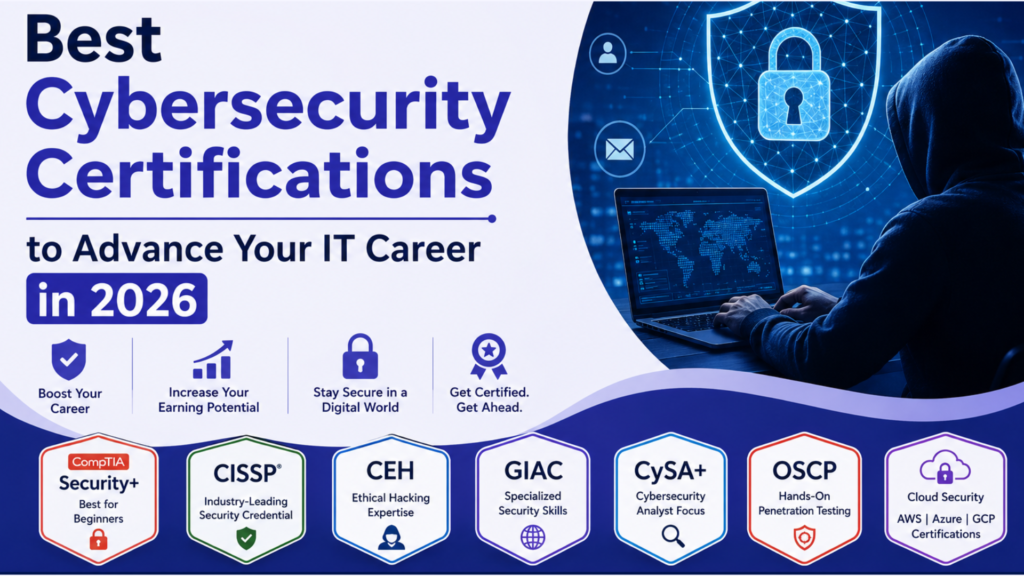
Best Cybersecurity Certifications to Advance Your IT Career in 2026
Cybersecurity isn’t just another IT specialty anymore it’s one of the fastest-growing and most in-demand career fields worldwide. Organizations of every size are investing heavily in security professionals to defend against ransomware, phishing attacks, cloud vulnerabilities, and data breaches.
The challenge for many aspiring professionals isn’t deciding whether to pursue cybersecurity it’s figuring out which certification is worth earning first.
With dozens of respected certifications available, choosing the right one can feel overwhelming. Should you start with CompTIA Security+? Is CISSP worth it? What about Certified Ethical Hacker (CEH), GIAC, or OffSec?
This guide breaks down the best cybersecurity certifications for every career stage, explains who each certification is designed for, and shares practical study strategies to help you pass your exam with confidence.
Why Cybersecurity Certifications Matter
Employers increasingly use certifications to verify technical skills before hiring or promoting security professionals.
A recognized cybersecurity certification demonstrates that you understand industry best practices and possess the knowledge needed to secure networks, systems, cloud environments, and applications.
Benefits include:
- Better job opportunities
- Higher earning potential
- Increased credibility
- Stronger technical knowledge
- Career advancement
- Greater employer confidence
While experience remains valuable, certifications often help candidates stand out in competitive job markets.
What Makes a Cybersecurity Certification Valuable?
Not every certification carries the same weight.
The most respected certifications typically offer:
- Industry recognition
- Vendor-neutral or specialized expertise
- Hands-on security concepts
- Updated exam objectives
- Career-focused skills
- Global employer acceptance
Before choosing a certification, consider your current experience level and long-term career goals.
Best Cybersecurity Certifications for Beginners
1. CompTIA Security+
Best For: Entry-level IT professionals
CompTIA Security+ remains one of the most recommended starting points for anyone entering cybersecurity.
It covers essential security concepts including:
- Network security
- Threat management
- Identity management
- Cryptography
- Risk management
- Incident response
Many employers view Security+ as a baseline qualification for security analysts, system administrators, and help desk professionals transitioning into cybersecurity.
Career Opportunities
- Security Analyst
- SOC Analyst
- IT Security Administrator
- Junior Cybersecurity Engineer
2. ISC2 Certified in Cybersecurity (CC)
Best For: Beginners with little or no experience
The ISC2 Certified in Cybersecurity credential introduces foundational security concepts without requiring years of industry experience.
Topics include:
- Security principles
- Access controls
- Network security
- Incident response
- Business continuity
It’s an excellent stepping stone toward more advanced ISC2 certifications.
Best Intermediate Cybersecurity Certifications
3. Certified Ethical Hacker (CEH)
Best For: Security professionals interested in penetration testing
The Certified Ethical Hacker certification focuses on understanding attacker techniques so security professionals can better defend systems.
Candidates learn:
- Vulnerability assessment
- Network scanning
- Web application security
- Malware concepts
- Social engineering
- Ethical hacking methodologies
CEH is widely recognized by government agencies and private organizations.
4. CompTIA CySA+
Best For: Security analysts
CySA+ emphasizes defensive security rather than offensive hacking.
Core topics include:
- Threat detection
- Behavioral analytics
- Security monitoring
- Incident response
- Vulnerability management
Organizations increasingly value analysts who can proactively identify threats before they become breaches.
5. GIAC Certifications
Best For: Experienced security professionals
GIAC offers numerous specialized certifications covering:
- Incident handling
- Digital forensics
- Malware analysis
- Cloud security
- Penetration testing
GIAC credentials are known for their technical depth and real-world focus.
Best Advanced Cybersecurity Certifications
6. CISSP (Certified Information Systems Security Professional)
Best For: Senior security professionals and managers
CISSP is considered one of the most respected cybersecurity certifications in the industry.
It validates expertise across multiple security domains, including:
- Security architecture
- Identity management
- Security operations
- Risk management
- Software security
- Asset security
Many leadership roles list CISSP as a preferred or required qualification.
Common Job Titles
- Security Architect
- Information Security Manager
- Security Consultant
- Chief Information Security Officer (CISO)
7. OffSec Certified Professional (OSCP)
Best For: Penetration testers
Unlike many multiple-choice certification exams, OSCP requires candidates to compromise real systems in a hands-on laboratory environment.
It emphasizes practical skills such as:
- Exploitation
- Privilege escalation
- Enumeration
- Buffer overflows
- Active Directory attacks
OSCP has earned a reputation for being challenging but highly respected.
Best Cloud Security Certifications
As businesses continue migrating workloads to the cloud, cloud security expertise has become increasingly valuable.
Popular options include:
AWS Certified Security – Specialty
Ideal for professionals securing AWS environments.
Microsoft Azure Security Engineer Associate
Focuses on Azure identity, governance, infrastructure, and threat protection.
Google Professional Cloud Security Engineer
Designed for securing workloads within Google Cloud Platform.
Cloud security certifications are becoming essential for organizations operating hybrid and multi-cloud environments.
Cybersecurity Certification Comparison
| Certification | Experience Level | Best For |
|---|---|---|
| Security+ | Beginner | Entry-level cybersecurity |
| ISC2 CC | Beginner | Foundations |
| CEH | Intermediate | Ethical hacking |
| CySA+ | Intermediate | Security analysis |
| GIAC | Intermediate/Advanced | Specialized security |
| CISSP | Advanced | Security leadership |
| OSCP | Advanced | Penetration testing |
Which Cybersecurity Certification Should You Choose?
The right certification depends on your career goals.
If you’re new to IT
Start with:
- ISC2 Certified in Cybersecurity
- CompTIA Security+
If you enjoy ethical hacking
Consider:
- CEH
- OSCP
If you prefer defensive security
Choose:
- CySA+
- GIAC
If you’re aiming for leadership
Work toward:
- CISSP
Remember that certifications are career tools not shortcuts.
Choose one that aligns with the type of work you actually want to perform.
How to Prepare for Cybersecurity Certification Exams
Passing cybersecurity exams requires more than reading study guides.
A balanced preparation strategy includes:
Study Official Objectives
Always begin with the exam blueprint published by the certification provider.
It outlines exactly what you’ll be tested on.
Build Hands-On Experience
Practice in virtual labs whenever possible.
Working with firewalls, SIEM platforms, Active Directory, Linux servers, and cloud environments reinforces theoretical knowledge.
Use Practice Exams
High-quality practice exam software helps candidates:
- Experience realistic exam simulations
- Improve time management
- Identify weak knowledge areas
- Build confidence before exam day
- Become familiar with question formats
Look for practice tests with updated question banks, detailed explanations, and performance tracking. These tools work best when combined with official study materials and hands-on labs rather than replacing them.
Review Incorrect Answers
One of the most effective study techniques is understanding why an answer is wrong not just memorizing the correct one.
Common Mistakes to Avoid
Many candidates delay certification success by making avoidable mistakes.
Common examples include:
- Memorizing answers instead of understanding concepts
- Ignoring hands-on practice
- Skipping practice exams
- Studying outdated material
- Waiting until the last week to review
Consistent preparation almost always outperforms last-minute cramming.
Career Opportunities After Certification
Cybersecurity certifications can open doors to a wide range of roles, including:
- Cybersecurity Analyst
- Security Operations Center (SOC) Analyst
- Penetration Tester
- Information Security Specialist
- Security Consultant
- Incident Response Analyst
- Cloud Security Engineer
- Security Architect
- Risk Analyst
- Compliance Analyst
As organizations continue strengthening their security posture, demand for certified professionals remains strong across healthcare, finance, government, retail, manufacturing, and technology sectors.
Frequently Asked Questions
What is the best cybersecurity certification for beginners?
CompTIA Security+ and ISC2 Certified in Cybersecurity are excellent starting points because they cover core security concepts and are widely recognized by employers.
Which cybersecurity certification pays the most?
Advanced certifications such as CISSP, OSCP, and specialized GIAC credentials are often associated with higher-paying security leadership and technical roles, though salary also depends on experience, location, and industry.
Is CEH better than Security+?
They serve different purposes. Security+ provides foundational cybersecurity knowledge, while CEH focuses on ethical hacking and penetration testing techniques. Many professionals earn Security+ first and pursue CEH later.
How long does it take to prepare for a cybersecurity certification?
Preparation time varies by certification and experience level. Beginners often spend two to four months studying for entry-level exams, while advanced certifications may require six months or more of focused preparation.
Are practice exams worth using?
Yes. Practice exams help simulate the real testing environment, improve time management, reveal weak areas, and build confidence. When paired with official resources and hands-on practice, they can significantly enhance exam readiness.
Conclusion
Choosing the best cybersecurity certification depends on your current skill level, career aspirations, and the type of security work you want to pursue. Entry-level professionals often benefit from starting with CompTIA Security+ or ISC2 Certified in Cybersecurity, while experienced practitioners may aim for CISSP, OSCP, or specialized GIAC certifications.
No matter which path you choose, success comes from combining structured learning with practical experience. Make the most of official study guides, hands-on labs, and reliable practice exam software that offers realistic exam simulations, updated question banks, detailed explanations, and performance insights. With consistent preparation and the right resources, you’ll be well-equipped to earn your certification and take the next step in your cybersecurity career.